Zeus and the Constitution: The Political Afterlife of Divine Authority
By Nada Al Mudhareb
Download PDF version
Zeus and the Constitution
The Political Afterlife of Divine Authority
And there sat an arbiter upon the circle of the heavens, supreme over all that is made;
whose lightning broke upon the earth, and did lay the foundations of absolute power,
breathing majesty into the hearts of men below.
Picture God.
And thus, almost instinctively, regardless of one’s personal beliefs, the image appeared: elderly, bearded, white haired, seated high above the world, surrounded by swarming clouds, radiating, in his wisdom, judgement, and supreme divine authority. One of the most recognizable images in human history - almost a global phenomenon when it comes to defining the face of He who reigns. Yet here, the majority’s thoughts on the matter conclude … not continuing to ask and wonder: why has humanity repeatedly imagined the ultimate authority in such a similar form? And more essentially, why, how, has one particular visual representation endured across thousands of years, survived the rise and fall of civilizations, existed beyond the transformation of religions, remained even throughout the rewriting of political systems?
The answer does not lie solely in the fields of religion, but it begins with knowing the difference between two terms: theology versus iconography.
Theology, the study of the divine and His relationship with the world, differs from Iconography, the visual language used to define and communicate meanings, ideas, and values. Thus, a religion's beliefs determine who or what God is, while iconography shapes how people imagine and represent the divine. This term explains how, throughout history, ideas have rarely travelled alone - carrying with them symbols, artistic conventions and expressions, and cultural memories. Here, while beliefs evolve and alter with the ever changing modernizing world, the symbols which represent them often remain deeply embedded within society’s collective imagination.
Cognitive science and deep psychology explain through anthropomorphic evolutionary models - those of which were formed by researchers such as Stewart Guthrie - that the human mind needs to visualize abstract concepts, wherein it naturally projects human-like agency onto conceptual ideas to make them more understandable. Scholars, such as Pascal Boyer, argue that highly memorable and “minimally counterintuitive” beliefs, such as a king who controls the universe, are unique, memorable understandings that transcend time and are optimized for long term survival. In this field, psychologically, this specific image triggers what Carl Jung identified as the universal “Wise Old Man”, or “King” - an elderly, bearded figure who represents order, law, and all-knowingness. Thereby explaining why symbols can outlive literal beliefs.
Here, we are introduced to one of history’s most enduring symbols: the King of Olympus, Zeus - the Ancient Greek civilization’s image of supreme authority, their elderly man on the throne. While his worship primarily disappeared centuries ago, his symbolic language did not; his image remains one of the world’s default visual language for divinity. From the commanding throne, to the flowing beard, to his association with justice, sovereignty, and cosmic order, Zeus became more than a Greek deity; through Roman adaptation, iconography, artistic renditions throughout the Renaissance and Christianity, and centuries of Western visual culture, he survived not only as a religion, but as an archetype of supreme authority and grand order. Herein, the political and symbolic vocabulary attached to his image continue to shape how power, legitimacy, divinity, and even God Himself were imagined and pictured in much of the Western world, and in their representations of legitimate ruling in the early states.
Long before modern states drafted legal frameworks and societal foundational answers to the ancient question of “Who has the right to rule?”, religion served as humanity’s earliest framework for understanding and legitimizing political order and its necessity. Giving anchor and weight to stabilize fragile human power dynamics, transforming raw force into structured and unquestioned authority, Zeus was a core example of an expression for that framework. As the ruler of the Olympian Gods, he was not merely an object of prayer, but the ultimate executive of the sky - providing a divine blueprint for human kingship, statecraft, and structured governance and ruling.
And so, we face a deeper historical question, that interrogates the philosophy behind what ideals live and die. How did Zeus become one of the most enduring archetypes of divine authority, and how did his iconography and symbolism influence later conceptions of political legitimacy, sovereignty, and the visual imagination of God? In our world, this is a case study, an extension of an argument that requires us to understand that this image has survived not only as an inheritance from mythology, but as an idea supported by politics. In tracing Zeus’s transformation from a ruler, to a symbol of sovereignty, to a translated idea influencing neighboring societies, to a visual reinterpreted by artists, to a picture that survived modern culture, we uncover the reasoning behind his longstanding existence in our imagination. Can symbols become more powerful than the religions and foundations that created and birthed them?
Picture Justice, as she is blindfolded and robbed, her scales balanced in an outstretched hand - then picture Death, cloaked and hidden, scythe resting near a mortal life - picture Britannia standing over an empire - picture Uncle Sam pointing a finger towards duty.
Long before Zeus ever claimed his throne upon Olympus, humanity had already established the governing habit of the mind: where the abstract, invisible, and incomprehensible, would not be permitted to remain abstract, invisible, and incomprehensible for long. They’d be given a face, a symbol, a visual - it is how the human mind instinctively imagines concepts and theories, primarily authority, to organize its knowledge and survive in a world it cannot fully see, hear, or touch.
When wondering why the mind cannot leave a force for less and impersonal, and why imagery plays such an outsized role in communicating authority, the answer comes with anthropomorphism. In other words, humanity’s tendency to project human minds, intentions, and faces onto entities and forces that possess none of these human qualities. Anthropologist Stewart Guthrie, in his foundational work, Faces in the Clouds, argues that this reflex of ours is an evolutionary strategy, constantly sharpened in every generation. Think as an example: while mistaking a shadow for a predator can be harmless, mistaking a predator for a shadow can cost everything. Thus, man defaults to detect identity wherever uncertainty exists - what Guthrie refers to as systematic anthropomorphism, where people perceive human-like agency in weather, law, and political order. Thus, observing this in religion is simply the habit operating, where the invisible is given a face, the impersonal made personal, all so it can be reasoned with, obeyed, or feared.
Nevertheless, this concept alone does not explain why one figure out of a thousand competing ones stands and dominates a civilizations imagination while outliving its own theology and foundation. As per cognitive scientist Pascal Boyer, cultural ideas survive transmission when they are mostly ordinary, but with enough violation of unexpected reality to be memorable yet startling while being easy enough to pass on. And so, a God who is a King who looks, feels, and rules as an earthly one does, except that his throne is the sky itself and his words bend weather and fate, satisfies the requirements to guarantee cultural survival. Thus, belief becomes a symbol, and symbol outlives belief.
Here, it is necessary to highlight the difference between theology and iconography. In theology, there are concerns into or with what a religion holds to be true about the divine, in its nature, in its will, in its relationship to creation. While in iconography, there is concern with the visual language through which the divine authority is depicted, recognized, and reproduced across generations. A theology may insist that God is formless, or beyond depiction entirely, - and still, the people will produce thrones, beards, crowns, and clouds, because the collective imagination or image exists, even when the doctrine forbids one. In this, it is observed that symbolism does not illustrate belief solely, it operates with an autonomy that allows it to persist after and beyond theology, even after what produced them has been abandoned.
This autonomy is sustained through mechanisms of transmission that operate beneath our conscious. Anthropologist, Harvey Whitehorse, who works in the cognitive science of religion demonstrates that the images and rituals that endure through generations are those transmitted through vivid, repeated, and emotionally charged experiences rather than abstract instructions alone. Again, here, a carved throne, a father in the sky, a man who judged and punished with thunder and lightning - they possess a distinct and powerful imprint on the human mind which carries a reservoir of patterns, or archetypes, wherein of the most persistent is the idea of the Wise Old Man or King. An elderly, bearded, white-haired, enthroned figure, old in age to depict his timeless wisdom, and whose existence depicts the victory of order and authority and law over chaos and destruction : the one on the throne depicts the defeater of all evil, and the bringer of order. And so, as one attempts to search for a face to give their highest authority, they do not invent one from nothing, but rather, unknowingly reach into a similar center.
Ultimately, proving through anthropology, counterintuitive designs, and ritual transmissions and archetypal memory, how this imagery and visual so consistently outlasts the theologies that birthed them through their place in iconography. This way, it is explained that once certain images settle to become the face of authority, the people, the minds, are reluctant to let it go. This same reflex, sharpened with every generation, is what pushes people to look up to the sky and think not of a void, but of a king.
Why of all figures competing for the throne above does one bearded, storm wielding sovereign from a Mediterranean civilization become the template that the west turns to again and again? Here, we turn from the mechanisms of the human mind, to the particular history, of one particular depiction of God: Zeus.
Hesiod’s “Theogony” frames the history of the universe to have a long and violent search for order and stability, he begins by introducing Uranus and Cronus, the tyrannical leaders and rulers who preceded Zeus, securing their power through paranoia and consumption. Thus, they’d devour their successors to maintain their reign, and ultimately fell and collapsed under their own violence. Here, when Zeus overthrows their leadership, his first act is to distribute honors and rights among his fellow Olympians, contrasting the assertion of dominance displayed by those before him. Herein, Zeus divided power, and invented institutional order. And as put by Walter Burkert in “Greek Religion”, he pushed his authority through calculated alliances, from his marriage to the face of wisdom, and Themis, the face of divine law. Thereby, creating an image of sovereignty, defined by power alongside wisdom and law.
Zeus was cast through religion as the guardian of balance and morality, as he’d reward lawful conduct, and punish and vanish acts that threatened it. Justice, within this, was not an abstract concept, it was the mechanism by which Zeus used and exercised his power ; he was a ‘God’ that could be trusted to preserve balance and harmony, and thus, his throne was inseparable from his function as the final arbiter.
That function of his extended into two offices that reveal just how thoroughly Zeus and his authority were woven into human society. As Zeus Horkios, he stood as the supreme protector of oaths, and in a world with no centralized court and police and binding contracts, sworn oaths were the law; herein, breaking one was not a private failure, but an act of treason that threatened order, like an offense that demanded divine retribution. Meanwhile, as Zeus Xenios, he protected and upheld Xenia, which is the law of hospitality, enforcing obligations between his subjects, like host and guest, or like traveler and stranger. Here, he offered to human society the first framework for diplomacy, specifically between city states, a guarantee or framework for trade, travel, and peaceful contact. And so, as put by Parker in ‘On Greek Religion’, Greek religious life was not separable from civic life, they were tied together, they were interwoven - rituals, oaths, obligations, they all connected the civilization, and Zeus stood as their guarantor and guardian.
These heavily detailed and intricate depictions would not have carried political weight had they not been granted visual language to facilitate their communication - and so, Zeus’s throne became essential, not for artistic purposes but to clearly be a symbol of politics. The throne elevated him from his fellow Olympians, with his iconography depicting not only a powerful being, but also his legitimate, just, followed, respected leading and rule. In Homer’s Iliad and Odyssey, human kings did not derive their power from their own strength and riches, they derived it as a right or gift from Zeus, an ancestral, sacred mandate to dispense and pass on justice. Therefore, political order amongst humans was derived and mirrors a divine one. The kings ruled well because they could do more than conquer, like Zeus, they could preserve total equilibrium and boundaries.
When seen through this lens, Zeus’s enduring image was not about mythology, it was through ideals of political philosophy, as he proved that sovereignty that’s not conjoined with legitimacy is tyranny and will collapse, just as what occurred with Cronus and Uranus. While individual kings fell and their cities rose and evolved with time, Zeus represented more of a system or structure where power was bound to justice and oath and order, which was durable, and answered the needs that a single ruler could not satisfy completely by himself.
With time, the temple fell silent, the altars went cold, the priests ascended to meet the one they’d dedicated life to, nobody there to bow and pray to the divine sculpture and tapestries. This is the date that eventually met nearly every shrine dedicated to the worship of Zeus. Under the spread of Christian’s across the Roman world and Europe, Ancient Greek worship declined. And yet… his figure remained. So how did Zeus become Jupiter, and why did his transformation impact politics so profoundly? The survival of Zeus cannot be explained or attributed to the survival of Greek religion, because it did not survive. It can be explained by the fact that Rome did not erase the civilization it conquered, rather, absorbed it, and thereby, inherited its Gods.
This process of absorption operated through a very specific mechanism, interpretation Graeca and interpretation Romana. Here, instead of discarding the religion and beliefs of the people whom they conquered and encountered, the Greeks and Romans identified foreign gods with their own, thereby matching them by shared function and character rather than treating them as separate beings entirely. Here one room is expanding military and administrative machines, absorbed and learnt and fragmented the Greek world. They did not simply imitate Hellenic art. Instead, they moved to Translate and transform her sovereignty into Roman terms and Roman characters. In this process, Zeus was utilized as the blueprint and map to create and form Jupiter, the chief deity of the Roman pantheon. In this translation, Jupiter retained nearly everything that had defined Zeus, and that had created or been a part of the formation of his character; from kingship to dominion over the heavens to the command of thunder to guardianship over justice to being the protector of oaths. Nevertheless, in this new depiction, this character’s role was now fused into the machinery or into the belief system of an empire that Zeus had never been designed to govern. Here, the name had changed, but more importantly, the scale had changed as well, where a localized mythological king became the universal administrative guarantor of an empire whose reach and power crossed beyond continents.
Greek religious life had been organized loosely surrounding independent city states, wherein each of the city states had their very own civic character, this was an aspect that contrasts strongly with the way Rome built religion directly into the architecture of the state. At the absolute center and pinnacle of this civic theology stood Jupiter Optimus Maximus, whose name translates into Jupiter, best and greatest. In this system, Jupiter’s temple on the Capitoline Hill, functioned beyond simply being a sanctuary for his worship. It was also one of the most significant political spaces in the republic, and later the Roman empire. As classicist Mary Beard observes, Roman religious identity was inseparable and deeply integrated into their civic and political office, wherein as a means of or in order to hold a magistrate or command an army, one must or had to act as a living agent of the state’s contract with its gods. In this aspect, historian John Scheid, in An Introduction to Roman Religion, emphasized that Roman state religion operated on the principle of preserving the peace between Rome and its gods. Triumphing generals and rulers gave thanks and expressed gratitude to Jupiter, following or after their victory, magistrates swore the most sacred oaths in his name as well, and additionally, senate decrees and public treaties were expressed and carried with his implicit witness, and therefore Jupiter was not a distant deity who was referred to as times of private salvation, he was considered the divine cause and reasoning for Rome’s constitutional order, and he was the justification for people or different rulers rights to govern the Mediterranean.
Conquest, however, has never been merely the movement of armies; it is equally the movement of language, law, and image. As Rome's borders expanded across Europe, North Africa, and the Near East, it exported not only its administrative systems but also brought with it, its religious iconography alongside them. Historians conclude or believe that establishing a new colony or provincial capital began, almost ritually, with the construction of a Capitoline temple to Jupiter, where the action was not a form of incidental piety, but acted as a political statement that visually declared that local custom and local law now sat subordinate to the supreme executive authority of Rome. Coins carried Jupiter's likeness into every marketplace; public monuments proclaimed his protection over the state; and by the height of empire, the visual vocabulary of an enthroned, bearded ruler commanding the sky had become recognizable all the way from Britain to Syria. Thus, conquest pushed and spread the belief systems and ideas precisely because the conqueror's visual language and systems of belief would become the mandatory center of every aspect of life; from currency to trade to law, Rome ensured that the image of Jupiter was expressed and drawn onto every meaningful, representative surface.
This visual framework reached its fullest political weight with the rise of the principate under Augustus and the emperors who followed. The transition from republic to autocracy demanded a mythological justification deep enough to make unprecedented personal power appear legitimate rather than seized to avoid fingers and points that screamed or called out tyranny. This was a worry that Roman emperors met and mitigated through deliberate imperial iconography. Coinage and monuments frequently depicted the emperor seated beside Jupiter himself, receiving a globe or a small statue of Victoria directly from the god's hand, thereby serving as a visual claim that imperial authority flowed downward from cosmic authority, and that this power and place was inherited and a right, blessed to them and gifted from the Lord’s hands and by his permission. In the ritual of the Roman triumph, a victorious general donned a purple toga and painted his face red to match Jupiter Optimus Maximus's own cult statue, engaging in a process that worked towards transforming himself, for one procession through the packed streets of the capital, into a living avatar of the supreme god.
Yet Rome's true legacy was never the preservation of Jupiter as an object of worship; it was the preservation of the symbolic language built around him to instill and maintain and uphold control, power, and public order. Symbols embedded in art, coinage, architecture, and civic ritual routinely outlast the specific beliefs that first produced them, and by the time Christianity rose to dominance within the empire, generations of artists and citizens had already inherited a fully codified visual understanding of what supreme authority looked like, and so, we repeat the description once more: elderly, bearded, enthroned, holding the instruments of cosmic law. Zeus survived, in other words, because Rome detached his image from the geography and religion that first produced him, and which fell and abandoned its foundational ideas, thus transforming a localized Greek king into permanent administrative vocabulary for an empire that spanned continents. This was or can be defined or explained as an imperial translation that laid the structural foundation for nearly all later European visual traditions of power.
And so, to continue the investigation, as Rome had successfully codified this pagan image of absolute authority into a universal language, the question that follows is unavoidable: what happened when the empire itself underwent collapse? How did this deeply embedded visual architecture survive not only the fall of Western Rome, but the rapid rise of state sponsored Christianity that had once sought to erase it entirely?
Picture a catacomb wall, dim and unadorned, marked not with the face of God but with a fish, an anchor, a young shepherd carrying a lamb across his shoulders. This was the visual world of early Christianity - a movement that, for its first centuries, deliberately avoided grand images of the divine. How, then, did the visual language of Zeus continue after belief in Zeus itself had disappeared? The answer is not that Christianity borrowed Zeus's theology, because instead, it explicitly rejected it, naming him a false idol. The answer is that Christianity inherited something quieter and more durable than belief: an artistic civilization whose visual grammar for depicting supreme authority had already been perfected centuries before Christ was born.
Influenced by Jewish traditions who were wary of graven images and operating for generations under Roman persecution, the earliest Christians relied on symbol rather than portraiture, as can be seen through the ichthys, the Chi-Rho, the beardless Good Shepherd of the underground catacombs. Herein, as art historian Robin Jensen explains in Understanding Early Christian Art, early Christian visual culture prioritized theological meaning conveyed through recognizable symbols over any literal, physical depiction of God. There was, quite simply, no accepted face of God yet - the written Scripture offered no physical description to paint from.
That changed decisively with the Edict of Milan in 313 CE and the subsequent Christianization of the Roman state. Once Christianity moved from persecuted minority to imperial religion, the Church confronted an urgent problem of visual communication: how does one project cosmic majesty and unquestionable authority to a sprawling, multi ethnic population that had spent a thousand years learning to read power through the naturalistic visual vocabulary of classical paganism? The Church did not invent a new grammar to solve this. It borrowed the most prestigious visual shell already available in its cultural environment - the iconography of Zeus and Jupiter. This was not theological borrowing but instead can be explained as an artistic inheritance: workshops, sculptural technique, compositional convention, and ideals of dignified beauty survived the empire's religious transformation intact, even as its official gods did not. Byzantine craftsmen decorating the domes of imperial basilicas drew directly on the formula of Phidias's lost cult statue of Zeus at Olympia - once again, enthroned, bearded, robed - to construct the image of Christ Pantocrator, the stern, all powerful judge seated in majesty, one hand raised, the other resting on a book of law rather than a thunderbolt.
This visual inheritance did not fade with time; it deepened, reaching its most articulate expression during the Renaissance revival of classical antiquity, wherein Renaissance artists saw no contradiction between pagan form and Christian meanings, where their beliefs lied, instead, in that the idealized anatomy of Greco Roman sculpture was the finest available vehicle for expressing divine perfection. Art historian Erwin Panofsky, in his study of Renaissance visual culture, describes this process as a kind of disjunction: a classical form preserved intact while its meaning is entirely reassigned. Artists painted God as an elderly, bearded, enthroned patriarch not because they secretly venerated Olympus, but because that beard, that throne, and that commanding stillness had become the only visual dialect the Western artistic tradition possessed for expressing wisdom, permanence, and sovereign law. This is precisely the line the outline of this study insists on holding clearly: theology asks who God is; iconography asks how God is seen. Christianity transformed the first answer completely while inheriting the second almost unchanged.
No single work demonstrates this more vividly than Michelangelo's Creation of Adam, painted across the vault of the Sistine Chapel. Michelangelo abandons the static enthroned God of medieval art entirely, replacing him with a windswept, muscular patriarch surging across the heavens, arm extended toward Adam in the instant of creation. Yet the body itself is a direct descendant of classical form, a physique Michelangelo built from years spent studying Roman sculptural fragments such as the Belvedere Torso, applying the same anatomical reverence the ancients had reserved for their gods. The result is a God whose face and form are barely distinguishable from a classical cloud gathering Jupiter, even as the theological content is entirely Christian.
Michelangelo pushes this inherited grammar even further in The Last Judgment, painted on the chapel's altar wall two decades later. Here Christ appears not as the meek, suffering figure of the Gospels but as a colossal, muscular, and terrifying cosmic judge, his right arm sweeping upward in a gesture that art historians have long compared to classical statues of Zeus hurling his thunderbolt against the rebellious Giants. The pose is inherited, even where the theology diverges sharply from anything Olympus ever represented. Raphael extends this same visual dialogue elsewhere in the Vatican, specifically and particularly in The Disputation of the Holy Sacrament and The School of Athens, and in his rendering of God the Father in The Vision of Ezekiel, arms outstretched in an expansive gesture, and moreover with his facial structure and enthroned gravity mirroring and being designed similarly to the ancient cult statues of Jupiter Optimus Maximus almost precisely. For Raphael, as for Michelangelo, classical antiquity was never treated as a theological rival, and it was treated as cultural or artistic inheritance, a visual civilization worth preserving even while its gods were being replaced.
This continuity must not be mistaken for continuity of belief. Christianity did not inherit the faith of the Greeks; it inherited the artists, workshops, and visual conventions that faith had spent centuries refining. Religious doctrine can transform completely within a single generation, but artistic tradition moves far more slowly, because a successful image is copied by apprentices, admired by patrons, and preserved on church walls long after the civilization that first produced it has vanished. Zeus's true legacy, then, was never religious, but instead it was visual.
A prompt typed into an image generator, requesting nothing more specific than "supreme authority" or "the ruler of the universe." No mention of Greece. No mention of Olympus. And yet, more often than not, what returns is a repeat of this analysis’s favorite description: an elderly, muscular, white bearded figure, enthroned, and robbed. How can or would it be possible for a god to disappear while his symbolic language remains so completely intact that even a machine, trained on millions of unrelated images, reproduces him by default? The fall of a religion, as the modern situation proves, it turns out, does not require the disappearance of the ideas, images, and symbols that religion created. Ancient Egyptian deities are studied millennia after their temples went cold. Norse mythology continues to shape literature and film long after Viking religious practice vanished. And by this understanding and visual proof, it is concluded that Zeus belongs to this same pattern: he did not survive because anyone still worships him, but instead because he stopped being a god and transformed into an idea.
This phenomenon is best understood through the concept of cultural memory. Cultural historian Jan Assmann distinguishes between communicative memory - which can be defined as the short term, everyday recollection that fades within roughly three generations - and cultural memory, a specialized, long-term system of texts, images, and symbols that a civilization deliberately preserves to stabilize its own identity across centuries. Zeus's image did not remain in circulation through anyone's living recollection of Greek religious practice, and it instead moved and it migrated into this deeper, institutional layer of memory, carried by art, architecture, and text, long after the last sacrifice was offered at his altars. Furthermore, the cultural historian Aby Warburg described a closely related mechanism, coining the term Nachleben der Antike - which in english is written as the "afterlife of antiquity" - to or as a means utilized to explain how emotionally charged classical images lie dormant within a civilization's visual imagination until a later culture needs, once again, to express something like absolute majesty or cosmic command, at which point the ancient image reawakens almost automatically. Zeus's enthroned, bearded silhouette is precisely this kind of dormant symbol, and it is one that requires no belief to be summoned, only the need for visualization and imagination.
The durability of that symbol rests on the efficiency of his iconography. Symbols survive when they communicate complicated ideas instantly, without requiring explanation, and the image of Zeus, which again are mature, bearded, enthroned, and presents him to be commanding thunder from the sky, communicates authority to a viewer who knows nothing of Greek mythology at all. What endures is not really Zeus the character, but what his image represents: ideals surrounding hierarchy, judgment, sovereignty, and power over forces beyond ordinary human reach; Because societies never stopped needing a shorthand for those same concepts, the visual vocabulary built around Zeus never stopped being useful, even as the religion that produced it disappeared entirely.
This is also a story of symbolic inheritance. Civilizations rarely invent their visual languages from nothing; they inherit them, and then repurpose them for entirely new ends. Truly, we may view the reference where the Renaissance did not revive classical imagery because Europeans wished to restore Greek religion, but it did so because antiquity had come to symbolize knowledge, beauty, and civilization itself, independent of any god. Modern popular culture operates on the same inherited logic. A viewer does not need to have read the Theogony to recognize Zeus as "king of the gods" the instant he appears on screen; centuries of storytelling have already done that translation work in advance, transforming a regional Greek deity into a global cultural archetype legible to almost anyone.
Literature carried much of this inheritance forward, wherein writers and authors across centuries returned repeatedly to Greek myth not out of nostalgia but because it offered a durable vocabulary for discussing power, ambition, and moral order which was globally accepted and recognized - it was or followed a set of vocabulary that later generations could reinterpret rather than simply repeat. That same instinct now drives modern entertainment, for as we can see in recognizable areas such as the iconic Disney's Hercules (1997), Zeus was introduced to a generation of viewers who likely never encountered Greek religion academically at all, and while the film substantially softened and moralized him, it preserved the essential shape of his cultural image: a booming, benevolent, white-bearded, lightning in hand, and all-powerful man - the ultimate source of heroic legitimacy. Marvel extends the same inherited shorthand in the opposite direction; for as we see in Thor: Love and Thunder (2022) and across Marvel Comics more broadly, Zeus appears as a stand in for an aging, self interested elite - a use of the character that depends entirely on audiences already recognizing him as a figure of hierarchy and inherited power before the story explains anything. Neither adaptation requires the viewer's belief and instead move towards choosing to depend on the viewer's recognition, this conclusively stands as proof that the archetype, not the theology, is what actually survived.
This same visual grammar resurfaces constantly outside of named mythology altogether. Storytellers reaching for an ultimate authority figure, a wise, unshakeable elder whose word settles every conflict, instinctively default to the same long beard, flowing robes, and commanding stillness that once belonged to Zeus and Jupiter - look back at Gandalf, Dumbledore, the senior Jedi councils of Star Wars, the pattern amongst them is that they all draw, whether consciously or not, from the same archetypal well Carl Jung identified as the Senex. Advertising and branding follow an identical logic, reaching for the enthroned, bearded patriarch whenever a company wants to signal permanence, trust, or institutional legitimacy, with no mythological reference intended at all.
The clearest evidence that this pattern has become genuinely automatic, rather than culturally chosen, arrives in the age of AI-generated imagery, wherein or in the event that a user requests an image of "supreme authority" or "the ruler of the universe" from a generative model, the system does not return a formless abstraction or a neutral diagram of power. Trained on millions of historical artworks, classical sculptures, and Renaissance reinterpretations and old works, it returns, with striking consistency, an elderly, muscular man with a heavy white beard and an elevated, commanding posture - it is Zeus's silhouette, reproduced without a single line of code ever mentioning his name. The machine is not referencing Greek mythology; it is simply mirroring the deep statistical weight of human visual culture back at us, revealing just how thoroughly that culture has been shaped by one particular ancient image.
The survival of Zeus, then, is not a story about the survival of Greek religion, its explanation surrounds or is about the survival of symbols. The worshipper who once knelt at Olympia and the modern viewer who instantly recognizes an AI-generated god-figure are separated by nearly three thousand years, and yet both are responding to the exact same visual language: a powerful ruler elevated above humanity, associated with wisdom, judgment, and command over forces greater than any individual. Zeus disappeared as a god, and yet he endured, almost undiminished, as a symbol - because symbols, as this study has shown again and again, frequently outlive the very civilizations that first imagined them.
If a constitution, at its core, answers the question "Who has the right to rule?" - then what had answered that question before constitutions were ever written down?
To answer this, the modern, narrow definition of "constitution" as a legal text drafted by committee must be set aside, and we must proceed towards an understanding that is more broad. A constitution is simply the foundational framework that organizes a society, distributes power, and legitimizes the exercise of authority. Thus, or therefore moving on with that definition, religion was humanity's original constitution. Long before secular law codified who could rule and why, religious systems performed the same essential function: they explained why certain individuals held power, why that power deserved obedience, and what happened when it was defied - not a comparison that is meant to claim that ancient myth operated as modern statute and law, its more by function. But the function itself is unmistakable, and Zeus sits at its center.
In the ancient world, political authority and divine authority were rarely separable. Rulers did not claim legitimacy merely because they commanded armies, instead having claimed it because their rule was understood to reflect a cosmic order no human had authored. This linkage transformed obedience from a practical calculation into a moral obligation, and herein to defy the king was not simply to risk punishment, but to disrupt the structure of the universe itself and to be challenging or committing treason against the divine order that rested high above as well. Zeus's symbolism made this connection explicit rather than implicit. His authority, as earlier chapters established, was never rooted in force alone, as it was at the same time bound to justice, and to sworn oaths, and to the protection of hospitality amongst people, introducing diplomacy, and providing and establishing boundaries. The mythology surrounding him reflected a broader Greek conviction that stable society required more than a strong hand and furthermore also required recognized, binding principles that regulated behavior for ruler and ruled alike, as a means of maintaining order and balance - this was to bring and maintain harmony. In this way, Zeus offered an early symbolic model of sovereignty and became a figure that depicted authority which was justified not by domination, but by responsibility and a commitment to justice.
This same question - what makes authority legitimate - occupied political philosophy long after Zeus's altars went cold. Aristotle, in Politics, argued that humans are naturally political animals who form communities in pursuit of collective flourishing, or eudaimonia; the state, for Aristotle, was never merely a mechanism of control but a structure through which shared human ends could be achieved to come to the goals and reach the successes which the people desired for themselves. Sociologist Émile Durkheim pushed further into the mechanics of why such structures endure, arguing in The Elementary Forms of Religious Life that religious ritual and sacred imagery function as the literal glue of social cohesion - so here basically, the explanation lies in that when a society venerates a sacred symbol, it is, often without realizing it, venerating its own collective identity and shared values. To obey the law of a king linked to Zeus was not merely to follow a ruler; it was to participate in the harmony of the cosmos itself.
Max Weber's theory of authority gives this transformation its clearest structure. Weber identifies three forms through which power becomes accepted as legitimate: charismatic authority, resting on the extraordinary personal magnetism of a single leader; traditional authority, anchored in inherited custom and sacred continuity; and legal rational authority, founded on formal rules and impersonal institutions. Zeus's own mythological arc traces this exact progression in miniature: his overthrow of Cronus is an act of raw, charismatic power, but his subsequent reign, built on marriage and the distribution of honors among the Olympians, is an act of traditional authority, and works towards establishing his legitimacy and having it solidified as one that is anchored in sacred order rather than continued conquest. Religious systems like this one operated overwhelmingly through Weber's first two categories; and then modern constitutional states, by contrast, are built almost entirely on the third. The shift from divine legitimacy to constitutional legitimacy, then, is not the disappearance of humanity's need for authority to feel legitimate; it is a transformation in where that legitimacy is understood to originate.
That transition was neither smooth nor guaranteed to hold. Thomas Hobbes, in Leviathan, warned that without an overwhelming, centralized sovereign capable of enforcing order, human society would collapse into a state of nature - a war of all against all in which life is "solitary, poor, nasty, brutish, and short", and where humans behave as animals and the liberties and rights we deserve cannot be promised and shall be lost. For the ancient Greek imagination, Zeus functioned as precisely this kind of Leviathan centuries before Hobbes gave the concept a name: his role as Horkios, guarantor of oaths, and his command over cosmic order supplied the same stabilizing function Hobbes would later argue only an absolute sovereign could provide.
Carl Schmitt's Political Theology names what remains of Zeus as his relocation from a sky bound ruler and God to an idea that represents ruling and lordship amongst people. Schmitt’s thoughts behind the omnipotent lawgiver of the modern secular state occupy structurally the same position once held by the omnipotent god of antiquity. Here, when written constitutions finally replaced divine kingship, they inherited the same essential tasks their predecessors had always performed, when it came to defining the limits of power, establishing final judicial authority, and commanding a form of civic reverence that, however secular in language, still asks citizens to submit to something greater than any single individual.
This is why the symbols of ancient authority refuse to disappear, even once the political systems that produced them have been entirely replaced. The seated, bearded patriarch, born in Zeus's cult statues, translated into Jupiter by Roman imperium, absorbed into Christian art by Byzantine and Renaissance painters, and secularized once more by modern mass culture and machine-generated imagery, remains the default visual shorthand the human mind reaches for whenever it needs to picture supreme, legitimate power. The modern world writes its constitutions on paper now, not in myth, and so times have changed. But the architecture of the mind that first needed Zeus to make sovereignty imaginable has not been rebuilt from scratch; it has simply been repurposed, generation after generation, symbol of a surviving system.
Herein, this idea returns the study to the question posed at its very beginning: can a symbol become more powerful than the religion, and the civilization that first created it? Zeus offers a clear answer. He no longer commands sacrifice. No one fears his lightning or swears oaths in his name expecting divine retribution. And yet his face persists, whether this be in Renaissance ceilings, in animated films, in algorithmic art, in the very grammar political philosophy still uses to describe legitimate rule - it is unquestionable that Zeus outlived his own worship because the questions his image answered - who governs, why they should be obeyed, what holds a society together - never stopped needing to be asked. And though the paper has long since changed, the face on the cover, it seems, never fully did.
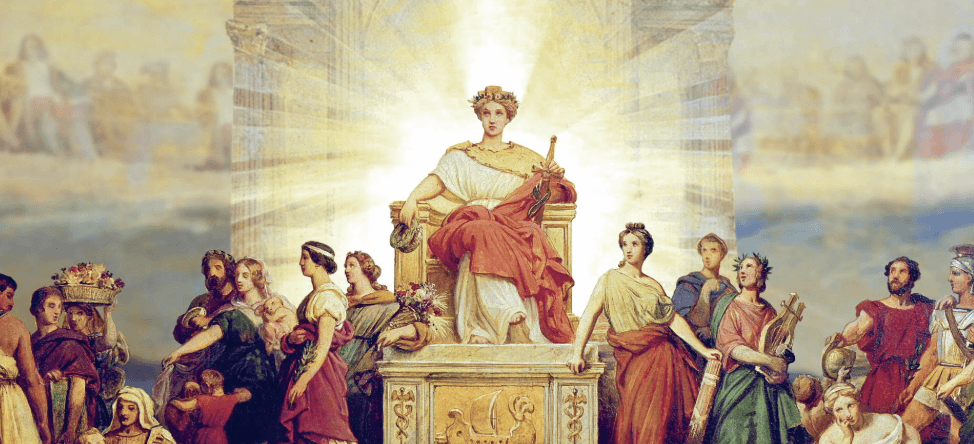
Picture, one final time, the arbiter upon the circle of the heavens, that very same figure this study opened with, elderly, bearded, enthroned above the clouds. By now, that image should look different than it did on the first page. It is not a portrait of God. It is not even, in any meaningful sense, a portrait of Zeus. It is a residue, or the last visible trace of a religion that no longer exists, worn smooth and repurposed by every civilization that inherited it since.
The story of Zeus is ultimately not the story of a god who survived. It is the story of a symbol that refused to disappear. His temples no longer function as centers of worship; the rituals once performed in his honor have vanished entirely; the religious world that produced him now exists only as historical memory, studied rather than practiced. And yet the image built around him - this bearded ruler seated above humanity, radiating wisdom, judgment, and supreme authority - remains one of the most recognizable visual signatures in Western culture.
This distinction between the survival of belief and the survival of symbols is the central insight this study has been assembling, chapter by chapter, since its opening question. Ideas rarely survive because a society continues to accept them in their original form; they survive because later generations transform them, strip them of their original context, and pour new meaning into an old shape. Rome did not preserve Zeus by preserving Greek worship - it dissolved that worship almost entirely, while translating Zeus into Jupiter and fusing his symbolism directly into the machinery of imperial legitimacy, and renaissance painters did not revive Greek religion when they gave God the Father Zeus's beard, his throne, and his commanding gesture, as they inherited a visual vocabulary perfected by pagan sculptors and repurposed it to serve a theology that had explicitly rejected the god who first defined that vocabulary. Modern culture does not worship Zeus when Disney, Marvel, or an AI image generator reproduces his silhouette - instead it simply recognizes him, because centuries of art and storytelling already did the work of making him recognizable, long before any of these later institutions existed.
What this study has traced, in other words, is cultural transmission, far from theology. Nothing here argues that Christianity is secretly a Greek religion in disguise, or that modern constitutional states are covert successors to Olympian myth. The argument is narrower: civilizations rarely invent their symbolic languages from nothing. They inherit them. They reshape them. They reinterpret them for entirely new purposes, while leaving the underlying grammar - whether this be in height, distance, age, wisdom, elevation, command - almost untouched. The identity behind the throne changed again and again, from Zeus to Jupiter to secular sovereign, nevertheless, the throne itself barely moved at all.
This is also, finally, a story about political power, not merely about art history. Long before written constitutions existed to answer the question of who holds the right to rule, religious systems answered it instead, binding obedience to something greater than any individual ruler's strength. Zeus was never simply a supernatural curiosity; he was an early answer to the same question every political system since has had to answer for itself - what makes authority legitimate, and why should anyone obey it? Modern constitutional states have replaced divine justification with legal-rational process, exactly as Weber's framework predicts. But they have not escaped the underlying question. They have only changed the vocabulary used to answer it.
Perhaps, then, the most significant lesson of Zeus's survival is this: a symbol can, under the right conditions, become more powerful than the belief that first created it. A religion can decline entirely, and yet the images, gestures, and structures it produced can continue shaping how a civilization imagines power for thousands of years afterward - long after anyone still believes in the god those images were originally built to represent. Symbols possess a strange, almost autonomous durability. They detach from their original context and drift forward through history, gathering new meaning at every stop, while somehow never losing the shape that made them recognizable in the first place.
This is, in the end, what the persistence of Zeus's iconography reveals about civilization itself: that societies do not only inherit laws, territories, and institutions from those who came before them - they inherit symbols, and those symbols become the invisible scaffolding beneath everything a culture believes it is inventing for the first time. The image of a supreme ruler elevated above humanity has lasted nearly three thousand years not because any single civilization decided to preserve it, but because it answers one of the oldest and least resolved human needs: the need to give a face, a form, and a throne to something too large and too abstract to otherwise be understood at all.
So the final question of this study is not why Zeus disappeared. The final question is why, after disappearing, he remained - worn into Roman coinage, folded into Christian drawings, reanimated in Renaissance chapels, and now surfacing, unbidden, in the output of machines that have never read a word of Hesiod. Can symbols become more permanently influential than the theological systems that first gave birth to them? Why do certain images of absolute authority endure across millennia while entire empires built to enforce them collapse into dust? And what does the sheer persistence of Zeus's face - across three thousand years, four civilizations, and one artificial intelligence - reveal about the actual limits of our own, supposedly secular, political imagination?
Because civilizations may abandon their gods, but they rarely abandon the symbols through which they once understood the world.
Guthrie, S. E. (1993). Faces in the clouds: A new theory of religion. Oxford University Press.
Britannica Editors (2026, May 19). Zeus. Encyclopedia Britannica. https://www.britannica.com/topic/Zeus
National Geographic Society. (n.d.). The gods and goddesses of ancient Rome. National Geographic Education. https://education.nationalgeographic.org/resource/gods-and-goddesses-ancient-rome/
Penn LPS Online. (2024, February 19). Explore the difference between Greek and Roman mythology. University of Pennsylvania. https://lpsonline.sas.upenn.edu/features/explore-difference-between-greek-and-roman-mythology
Supreme Court of the United States, Office of the Curator. (2003, May 22). Figures of justice [Information sheet].
Boyer, P. (2001). Religion explained: The evolutionary origins of religious thought. Basic Books.
Schena, D. A., II, Coverdale, M. E., & Nairne, J. S. (2019). Investigating the minimal counterintuitiveness effect [Poster]. Purdue Undergraduate Research Conference, Purdue University. https://docs.lib.purdue.edu/purc/2019/Posters/45
Whitehouse, H. (2001). Modes of religiosity: Towards a cognitive explanation of the sociopolitical dynamics of religion. Method & Theory in the Study of Religion, 13(3), 293–315.
Psychologist World. (n.d.). Carl Jung: Archetypes and analytical psychology. https://www.psychologistworld.com/cognitive/carl-jung-analytical-psychology
Dunea, G. (2025). Hesiod: The creation of the world. Hektoen International: A Journal of Medical Humanities. https://hekint.org/2025/10/30/hesiod-the-creation-of-the-world/
Dunea, G. (2025). Hesiod: The creation of the world. Hektoen International: A Journal of Medical Humanities. https://hekint.org/2025/10/30/hesiod-the-creation-of-the-world/
Roy, G. (2026, July 21). Xenia. Encyclopaedia Britannica. https://www.britannica.com/topic/xenia-sociology
Thompson, N. L. (2007). The Roman world: A sourcebook for educators. The Metropolitan Museum of Art. https://www.metmuseum.org/-/media/files/learn/for-educators/publications-for-educators/roman.pdf
Johnson, A. (n.d.). Christ Pantocrator: God, emperor, and philosopher: The Byzantine iconography of Christ [Master’s thesis, University of Georgia].
Pirenne-Delforge, V. (2012). On Greek religion. Bryn Mawr Classical Review. https://bmcr.brynmawr.edu/2012/2012.03.06/
Google Arts & Culture. (n.d.). Representations of Zeus: The king of the gods. https://artsandculture.google.com/
Barringer, J. M. (2015). The changing image of Zeus in Olympia. Archäologischer Anzeiger, (1), 19–37. https://publications.dainst.org/journals/aa/1911/5932
Westermann, C. (2023, July 5). sacred kingship. Encyclopedia Britannica. https://www.britannica.com/topic/sacred-kingship
Barker, C. (2024, September 2). Zeus comes in many forms on screen—just as he did in the original myths. University of Sydney. https://www.sydney.edu.au/news-opinion/news/2024/09/02/zeus-comes-in-many-forms-onscreen-just-as-he-did-in-the-original-myths.html
Mind Maestro. (2023, January 19). Reimagining Greek mythology with AI art. https://www.mindmaestro.co.uk/greek-mythology-art
Reimer, J. (2022, January 27). Images of the invisible God: How icons avoid idolatry. Commonweal Magazine. https://www.commonwealmagazine.org/images-invisible-god
Wright, D. F. (1990). 313: The Edict of Milan. Christian History, (28). https://christianhistoryinstitute.org/magazine/article/edict-of-milan
McWilliam, J., Puttock, S., Stevenson, T., & Taraporewalla, R. (Eds.). (2011). The statue of Zeus at Olympia: New approaches. Cambridge Scholars Publishing.
Waltmann, R. (n.d.). Don’t take Orpheus without the lyre: The intricacies of using pagan myths for Christian purposes in The Divine Comedy and Paradise Lost [Master’s thesis].
Freedman, L. (2011). Classical myths in Italian Renaissance painting. Cambridge University Press. https://assets.cambridge.org/97811070/01190/excerpt/9781107001190_excerpt.htm
Sistine Chapel. (2026). The Creation of Adam. https://www.thesistinechapel.org/the-creation-of-adam
Jones, C. P. (2020, May 19). Michelangelo’s inspiration: The Belvedere Torso. Thinksheet. https://medium.com/thinksheet/michelangelos-inspiration-the-belvedere-torso
van Beckum, B. (2018, January 18). Michelangelo and his ancient inspiration. Rome in Winter. https://romeinwinter.wordpress.com/2018/01/18/michelangelo-and-his-ancient-inspiration/
Assmann, J. (2008). Communicative and cultural memory. In A. Erll & A. Nünning (Eds.), Cultural memory studies: An international and interdisciplinary handbook (pp. 109–118). De Gruyter. https://archiv.ub.uni-heidelberg.de/propylaeumdok/1774/1/Assmann_Communicative_and_cultural_memory_2008.pdf
Michaelian, K., & Sutton, J. (2017, April 24). Memory. https://plato.stanford.edu/entries/memory/
Blackstock, J. (2024, September 28). What does alchemy have to do with psychology? -. Taproot Therapy Collective. https://gettherapybirmingham.com/blog/what-does-alchemy-have-to-do-with-psychology/
Constitution (vessel) | Encyclopedia.com. (n.d.). https://www.encyclopedia.com/social-sciences-and-law/political-science-and-government/political-science-terms-and-concepts/constitution-vessel
Religion and social order. (n.d.). Hoover Institution. https://www.hoover.org/research/religion-and-social-order
Kumar, P. (2026, March 7). The Divine Right to Rule: Understanding Ancient The God-Kings System • Sociology.Institute. Sociology Institute. https://sociology.institute/sociology-of-religion/ancient-divine-right-rule-god-kings-system/
Teo. (2026, August 7). Greek Mythology: Origins from Homer to Hesiod - AtCorfu. AtCorfu. https://atcorfu.com/greek-mythology/
How the Romans Used Greek Myths for Their Own Purposes | UNRV Roman History. (n.d.). https://www.unrv.com/articles/how-romans-used-greek-myths-for-their-own-purposes.php